


In this article

Innovation Readiness Assessment
A staff survey that shows, department by department, where work stalls.
Assess Your OrganizationKey takeaways
Prioritize strategic initiatives by the capacity of your people. Budget is rarely the limit that decides.
List every initiative in progress, with the hours a week it takes from named people.
Sort the list into core, adjacent and breakthrough work, and protect core first.
Give every initiative one of three answers: do it, test it more or shelve it.
Publish the order, including what stopped, so every department works from one list.
How to Prioritize Strategic Initiatives: Start With Capacity

Definition
Initiative prioritization
Deciding the order in which an organization gives people and time to its initiatives, including which initiatives wait or stop so that the first ones can be finished.
To prioritize strategic initiatives when resources are limited, begin with the resource that runs out first. In most organizations that is the time of the people who do the work, and the budget is rarely what holds an initiative back. Count that time first. Then sort the initiatives by kind, give each one a clear answer, and publish the order.
Most advice on prioritizing strategic initiatives recommends a scoring model: rate each initiative for strategic fit, value, effort and risk, then rank by score. A score puts the list in order. It does not make the list shorter, and the initiative in last place still expects the same people as the initiatives above it. The common models are compared, with a free template for each, in Idea Scoring Methods Compared.
This article explains how to prioritize strategic initiatives starting from what your people can carry, and ends with a method a leadership team can run in one meeting.
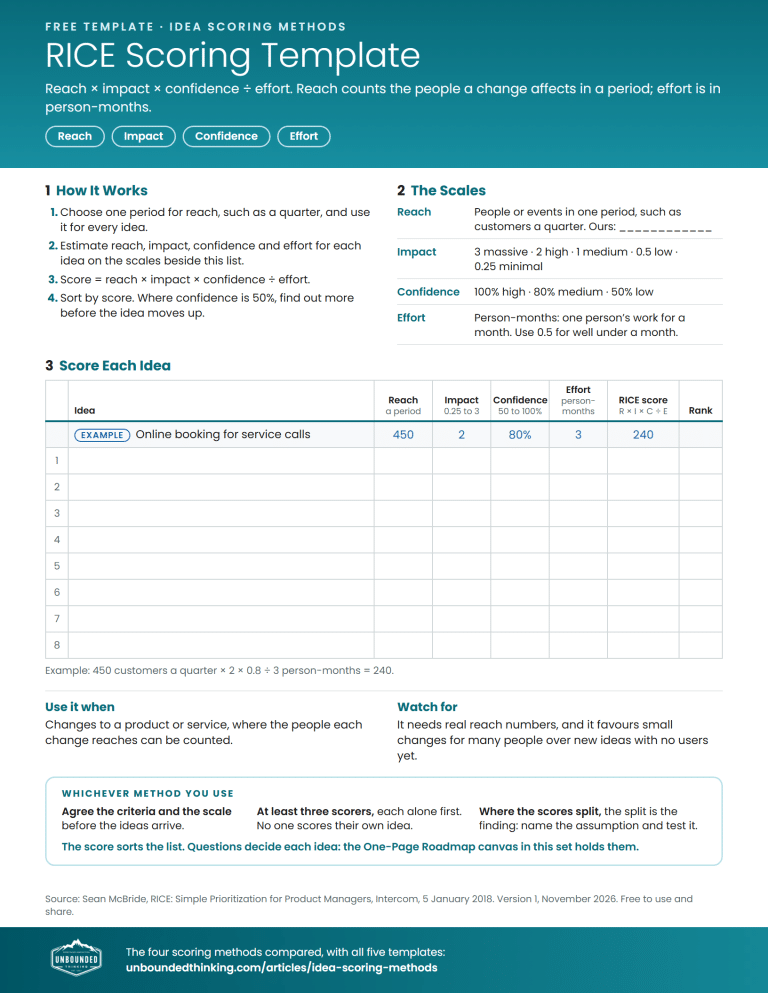
Free templates
Weighted scoring, impact and effort, ICE and RICE side by side, with a one-page template for each.
When Everything Is a Priority, Nothing Is
Few leadership teams decide to run more initiatives than they can staff. The list grows one reasonable approval at a time. Each initiative was approved on its own merits, and none was weighed against the others.
Rose Hollister and Michael D. Watkins named the result initiative overload in Harvard Business Review in 2018: leaders keep layering on initiatives, organizations find existing ones hard to end, and severe overload can follow at the levels below the executive team.
Employees describe this as too many priorities at work. When every initiative carries the same importance and every problem the same urgency, no one has a place to start. Each team chooses its own order, and work that depends on two departments waits for both.
A leadership team in this position needs something to hold on to: a shared definition of what counts as a strategic initiative, and one order that every department works from.
Capacity Decides How Many Initiatives Can Run
A budget can be moved by a decision. The hours in a working week cannot. The people a new initiative depends on usually have full weeks before it arrives, and the initiative is added to that load.
The shortage of time is widely reported. In Microsoft’s 2025 Work Trend Index, a survey of 31,000 knowledge workers in 31 markets:
80%
of the global workforce, employees and leaders alike, say they lack enough time or energy to do their work
53%
of leaders say productivity must increase
Source: Microsoft, 2025 Work Trend Index Annual Report, April 2025
Microsoft calls this the capacity gap: leaders want more output from people who report that they have no time left. Adding initiatives does not close it. Before approval, each initiative has two things to settle: who will do the work, and what those people will stop doing to make room.
Key idea
An initiative approved without the capacity to run it has not been approved.

In practice. Ask each sponsor for the hours a week the initiative needs and the names of the people who will give them. Add up the hours for each person across the whole list. Anyone committed beyond a full week marks an initiative that is waiting, whatever its status report says.
Sort the Work Into Core, Adjacent and Breakthrough
Initiatives of different kinds cannot be ranked fairly on one scale. A repair to the ordering process and a new line of business carry different risks and pay back over different periods. Sort the list by kind first.
A widely used split comes from Bansi Nagji and Geoff Tuff, whose article “Managing Your Innovation Portfolio” (Harvard Business Review, May 2012) describes three kinds of innovation work: core, adjacent and transformational. We use the same three and call the third breakthrough.
Core
Improve What Exists
Work that makes current products, services and processes better for the customers the organization already serves.
Adjacent
Extend What Works
Work that takes an existing strength to new customers, or adds a capability beside one the organization already has.
Breakthrough
Build Something New
Work on offerings or ways of operating that are new to the organization. The outcome is the least certain of the three.
Protect core first. Core work pays for everything else: it keeps the organization financially stable, and its results arrive soonest, which builds confidence for larger changes. When capacity is short, the first hours go to core initiatives. Adjacent and breakthrough work then receives a small, named share of capacity that is not borrowed back whenever a core deadline presses.
Give Every Initiative One of Three Answers
A priority list fails when its only answers are yes and silence. Every initiative, in progress or proposed, receives one of three answers, stated in the meeting and written down.
Do it
The Capacity Is Named
The initiative fits the strategy, and its people and hours are confirmed. It has an owner and a review date.
Test it more
The Case Is Not Yet Proven
The main assumption is untested. The initiative receives a small test and a date for the result.
Shelve it
The Time Is Not Now
The initiative is sound and no capacity exists for it. It is recorded with the condition that would bring it back.
The shelf is a real answer. A shelved initiative keeps its record, and its sponsor knows what would reopen it. If work had begun, it stops and its people are released. Initiatives left on the active list with no one working on them are what we call zombie projects, and our guide to innovation portfolio management explains what they cost.
Run a Small Test Before a Large Commitment
The largest commitments of capacity are often made on the least evidence: a business case is approved, a team is assigned for a quarter, and the first real information arrives months later.
Before an initiative takes a team for a quarter, ask what the smallest test of it would show. In our workshops this is Unbounded Thinking’s 2 Hour, $20 Test: a test of about two hours and twenty dollars answers most first questions sooner than a long pilot does.
Instead of
Approve the initiative on its business case
Assign a team for a quarter to find out
Review the result at the end of the quarter
Try this
Name the one assumption the case depends on
Check that assumption first, with two hours and twenty dollars
Bring the result of the test to the next meeting
A small test moves an initiative out of “test it more” on evidence, towards “do it” or towards the shelf. It also protects capacity, because a team’s quarter goes only to work that has passed a first check. Our article on idea implementation covers the small test for a single idea.
Stopping Work Is How Capacity Comes Back
Prioritizing strategic initiatives produces an order. It produces capacity only when something leaves the list. Hiring takes months, and a larger budget does not lengthen anyone’s week, so the hours for the initiatives at the top come from work that stops. A list on which every initiative keeps its place has been ranked, and the workload is unchanged.
Many initiatives that fail were decided poorly before the work began: approved without capacity, without a test, and with nothing stopped to make room. Our article on when to stop a project explains how to agree the conditions for stopping at approval, and how to close a project without blame.

Innovation Readiness Assessment
Measure Innovation Readiness in Every Department
Staff across every department assess process, people, projects and performance. Leadership receives a department-by-department view of where work stalls, with a prioritized 30- and 90-day action plan.
Prioritizing Strategic Initiatives in One Meeting: Five Steps
These five steps show how to prioritize strategic initiatives in a single leadership meeting. As preparation, each sponsor brings the hours and the names for their initiatives.
1
List everything in progress
Put every initiative on one list: under way, approved and not yet started, or begun without formal approval. Include those no one has reported on recently.
2
Name the capacity each one takes
Record the hours a week each initiative needs and the people who give them. Add up the hours for each person.
3
Sort by kind
Mark each initiative core, adjacent or breakthrough, and confirm the core work to protect.
4
Decide what continues and what stops
Work down the list, core first, and give each initiative its answer. When people’s hours are used, nothing more is added to “do it”.
5
Publish the order
Send one list to every department within a week: what continues, what is being tested, what stopped, and why.
The published order matters as much as the decision. Until departments see one list, each team keeps its own. A clear stop is easier to accept than an initiative that goes quiet.
Initiative prioritization checklist
One list of every initiative in progress or approved
Hours a week and named people beside each initiative
Each initiative marked core, adjacent or breakthrough
One answer for each: do it, test it more or shelve it
The initiatives that stop, and the hours each one releases
The order sent to every department, with the next review date
Repeat the meeting every quarter. A proposal that arrives between meetings receives the same three answers, and a “do it” names the work that makes room for it. Held on a schedule, the meeting becomes the organization’s initiative prioritization framework.
How well the method holds depends on how your organization already decides about its work. The Innovation Readiness Assessment asks staff in every department about process, people, projects and performance, and shows leadership where work stalls. For a first look, one person can take the free Innovation Readiness Snapshot.
Limited-time Q4 offer
Innovation Process Certification at 50% Off
Your team can build this on a real problem in our two-day Innovation Process Certification, for up to 10 people. Alberta organizations that book by 30 November pay half our medium business price.
Frequently Asked Questions
How do you prioritize strategic initiatives?
Start with capacity. List every initiative in progress, record the hours a week each one takes from named people, and sort the list into core, adjacent and breakthrough work. Give each initiative one of three answers (do it, test it more or shelve it), and publish the order.
How do you prioritize projects when resources are limited?
Treat the time of your people as the limiting resource. Add up the hours each person is committed to across all projects, protect core work first, and stop or shelve projects until the list fits the hours available.
How do you prioritize when everything is a priority?
Agree one definition of a strategic initiative and one order for the whole organization. Set the list against the capacity of the people involved, and test or shelve the initiatives that do not fit.
What is an initiative prioritization framework?
An initiative prioritization framework is an agreed way of deciding the order in which initiatives receive people and time. Most score each initiative on criteria such as strategic fit, value, effort and risk. A complete framework also checks the ranked list against capacity and names the work that stops.
What is the difference between core, adjacent and breakthrough initiatives?
Core initiatives improve existing products, services and processes for current customers. Adjacent initiatives take an existing strength to new customers or add a nearby capability. Breakthrough initiatives build something new to the organization. The split comes from Bansi Nagji and Geoff Tuff’s 2012 Harvard Business Review article, which calls the third kind transformational.
About the author

Shannon Phillips
Co-Founder and Innovation Strategist
Designs structured innovation systems for enterprise organizations and helps leadership teams set priorities that reflect how the organization operates.
Related Articles

Innovation Execution
When to Stop a Project: Kill Criteria for Innovation and Improvement Work

Innovation Execution
Why Good Ideas Are Not Implemented, and What to Change
Foundations