


In this article

Idea Management Software
KWOKKA by UBT™ collects ideas from employees across your organization and gives each one an owner and a defined path.
Book a WalkthroughKey takeaways
Weighted scoring, impact and effort, ICE and RICE are the four common idea scoring methods. Each was built for a different kind of decision.
Weighted scoring fits a short list judged on criteria that do not matter equally. Impact and effort gives a long workshop list its first sort in minutes.
ICE fits many small tests that are reordered often. RICE fits changes to a product or service whose reach can be counted.
Every method turns estimates into one number. Agree the scale first, score alone, and treat a split between scorers as a finding.
A score sorts the list. Questions decide each idea: whether the organization is ready, what the real problem is, and what the smallest test would show.
What Is Idea Scoring?

Definition
Idea scoring
Rating every idea on a list against the same questions, as a number or a place on a grid, so that the list can be put in order. A score sorts the list. It does not decide an idea.
Organizations that ask for ideas soon have more of them than people to work on them. A scoring method is the usual answer, and four idea scoring methods are in common use: weighted scoring, the impact and effort matrix, ICE and RICE. Most guides to them are written for product managers. This one compares them for a leadership or innovation team, with a free one-page template for each.
We should say where we stand. Unbounded Thinking does not use any of the four in its own work, for the reasons in What Every Score Leaves Out. We describe them fairly because many teams do use one, and each does its job well when it fits the decision in front of it.
Which Idea Scoring Method Fits Which Decision?
Each method was designed for a different decision, which is why no single one is best. The table sets out how each scores, when it fits, and what to watch for.
Method
How it scores
Use it when
Watch for
Weighted scoring
How it scores
Three or four agreed criteria, each with a weight. Each idea is rated on every criterion and the weighted ratings are added.
Use it when
A few ideas must be narrowed to one or two, and the criteria do not matter equally.
Watch for
Weights set after the ideas are known, and decimal totals that look more exact than the estimates behind them.
Impact and effort
How it scores
Each idea is placed on a two-by-two grid: the value it would bring against the work it would take.
Use it when
A long list from a workshop needs a first sort, in the room and in minutes.
Watch for
People read impact and effort differently, and the grid does not show how sure anyone is.
ICE
How it scores
Impact, confidence and ease, each scored from 1 to 10, then multiplied or averaged.
Use it when
Many small tests are compared and reordered every week or two.
Watch for
Three guesses from one person can lift a weak idea, and a 6 and a 7 differ less than they appear to.
RICE
How it scores
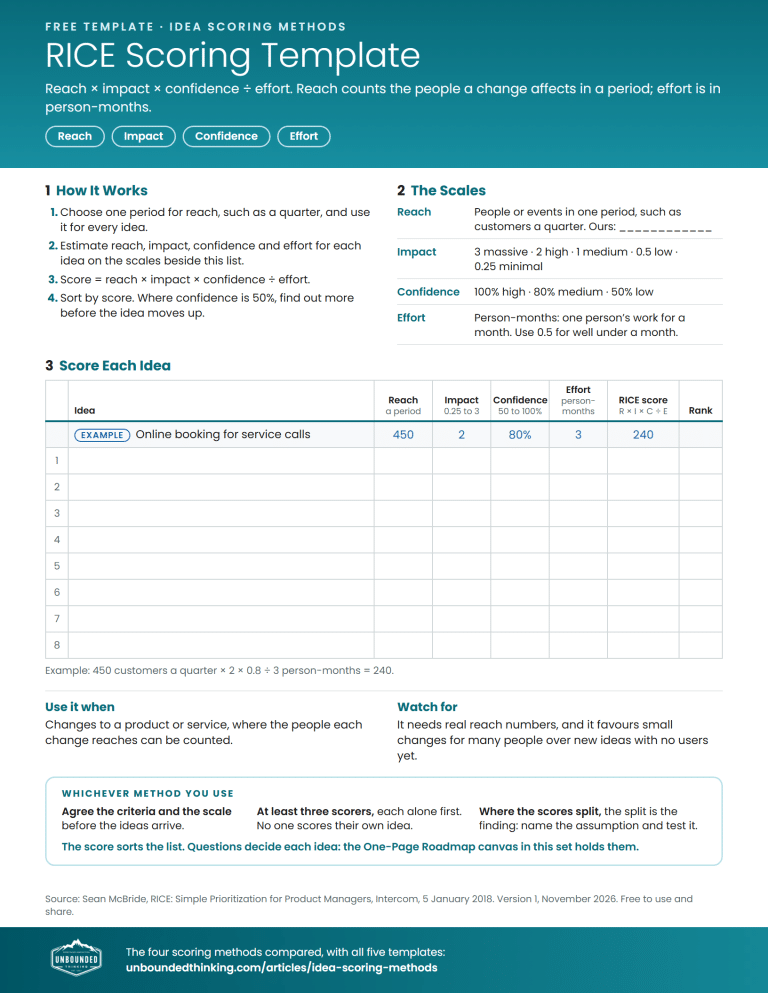
Reach × impact × confidence ÷ effort. Reach is people in a period, such as customers a quarter; effort is in person-months.
Use it when
Changes to a product or service, where the people each change reaches can be counted.
Watch for
It needs real reach numbers, and it favours small changes for many people over new ideas with no users yet.
Sources: Sean McBride, RICE: Simple Prioritization for Product Managers, Intercom, January 2018; Sean Ellis and Morgan Brown, Hacking Growth, Crown Business, 2017; ASQ, Decision Matrix.
To show how differently the four treat one idea, every template below scores the same example: online booking for service calls. Weighted scoring gives it 3.7 out of 5, ICE gives it 192 out of 1,000, RICE gives it 240, and the impact and effort grid places it among the quick wins. Each number helps to sort a list. None of them says whether to build it.
Weighted Scoring: When the Criteria Do Not Matter Equally
A weighted scoring model, also called a weighted decision matrix, starts with three or four criteria and a weight for each, set so that the weights add up to 100 percent. Every idea is rated on every criterion, often from 1 to 5. Each rating is multiplied by its weight, and the results are added into a weighted total.
In the template's example, online booking is rated 4, 3, 5 and 2 on four criteria weighted 40, 30, 20 and 10 percent, for a total of 3.7 out of 5. The strength of the method is that it makes a team say, before the ratings begin, which criteria matter most. Its weakness shows when the weights are set or adjusted after the ideas are known: a small change in one weight can reorder the list, and a 3.7 against a 3.6 suggests a difference the estimates cannot support.
Download the weighted scoring template (PDF, one page): criteria and weights first, a worked example, and room for nine ideas.
Impact and Effort Matrix: A First Sort in the Room
The impact and effort matrix places each idea on a two-by-two grid, with the value it would bring on one axis and the work it would take on the other. The four corners are usually called quick wins (high impact, low effort), major projects (high impact, high effort), fill-ins (low impact, low effort) and thankless tasks (low impact, high effort). The names vary, and the grid has no single author.
It is the fastest of the four. A group can place thirty ideas in a few minutes, which is why it often closes a workshop. Its weakness is that impact and effort mean different things to different people: one person's effort is a budget, another's is their own evenings. Agree what the two words mean before anything is placed, and discuss first the ideas whose place people disagree about.
Download the impact and effort matrix template (PDF, one page): the two words defined first, the grid, and a numbered list for twelve ideas.
ICE Scoring: Impact, Confidence and Ease
ICE scores each idea from 1 to 10 on three questions: how much impact it would have, how confident the scorer is, and how easy it would be. Most teams multiply the three scores; some take the average. The method is credited to Sean Ellis, who describes it with Morgan Brown in Hacking Growth (2017), for teams running many small growth experiments.
ICE suits a long list of small tests that is reordered every week or two, because each score takes seconds. Its confidence score is its most useful feature: it asks how sure the scorer is, which the other methods leave out. Its weakness is that all three scores are judgments, often from one person, and on a ten-point scale a 6 and a 7 differ less than they appear to.
Download the ICE scoring template (PDF, one page): what a 1 and a 10 mean, agreed first, and a scoring table with a worked example.
RICE Scoring: Reach, Impact, Confidence and Effort
RICE was set out by Sean McBride at Intercom in January 2018. The score is reach × impact × confidence ÷ effort. Reach is the number of people or events an idea affects in a period, such as customers a quarter. Impact uses a fixed scale from 3 (massive) to 0.25 (minimal). Confidence is 100, 80 or 50 percent. Effort is counted in person-months.
RICE asks for the most evidence of the four, and it is the only one that counts how many people an idea reaches. That suits changes to a product or service whose users can be counted. It suits new ideas less well. An idea with no users yet has no reach to count, and a small change for many people will usually outscore it.
Download the RICE scoring template (PDF, one page): the four scales from the original article, a worked example, and room for eight ideas.
What Every Score Leaves Out
All four methods turn estimates into one number or one place on a grid. That is what makes them quick, and it is also their limit. A number can put a list in order. It cannot say whether the organization is ready to take an idea on, whether the idea answers the real problem or only a symptom, or what the smallest test of it would be.
Key idea
A score sorts the list. Questions decide each idea.
This is why we use none of the four in our own work. Once a number appears, the discussion tends to stop, and the discussion is where an idea is decided. Unbounded Thinking asks questions of each idea instead, in four stages: Qualify (are we ready to take this on?), Clarify (what is the problem?), Ideate (what is the right idea?) and Explore (how do we test and implement it?).
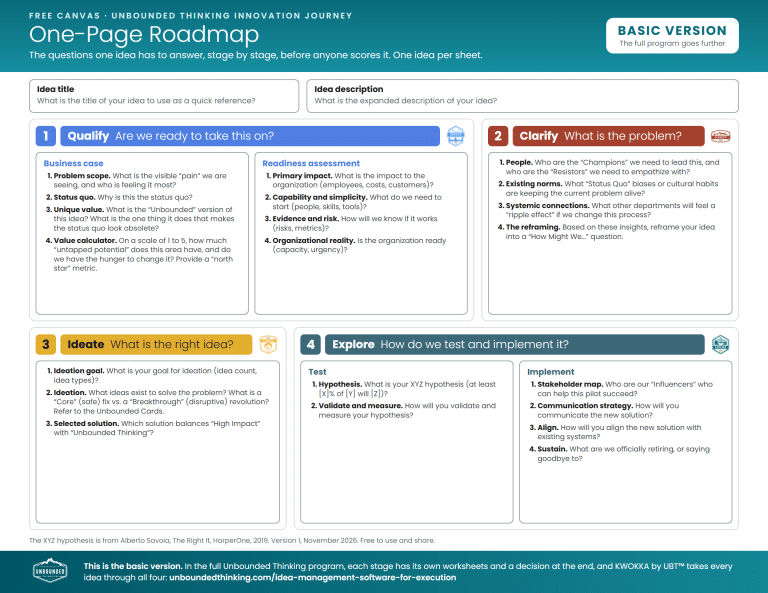
Free canvas, basic version
One-Page Roadmap (PDF, one page)
The questions one idea has to answer, stage by stage, on one landscape page. This is the basic version. In the full Unbounded Thinking program each stage has its own worksheets and ends with a decision, and KWOKKA by UBT™ takes every idea through all four stages.

Idea management software
Idea Management Software That Takes Ideas to Results
KWOKKA by UBT™ collects ideas from employees across your organization, helps your team decide which ones to pursue, gives each one an owner and a defined path, and records what it delivered.
Download the Five Free Templates
Each template is one page, free to download with no form, and free to use and share. Each scores the same example idea, so the methods can be compared side by side, and each ends with three habits that make any score fairer.
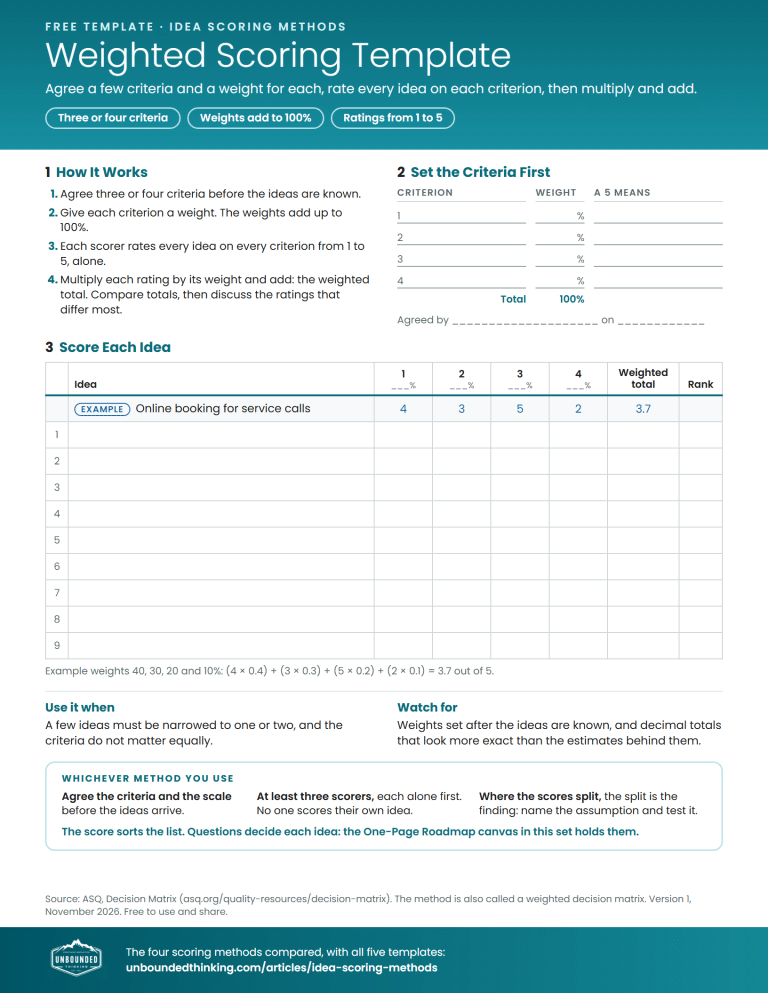
Criteria and weights first, then a scoring table for nine ideas.
PDF, one page
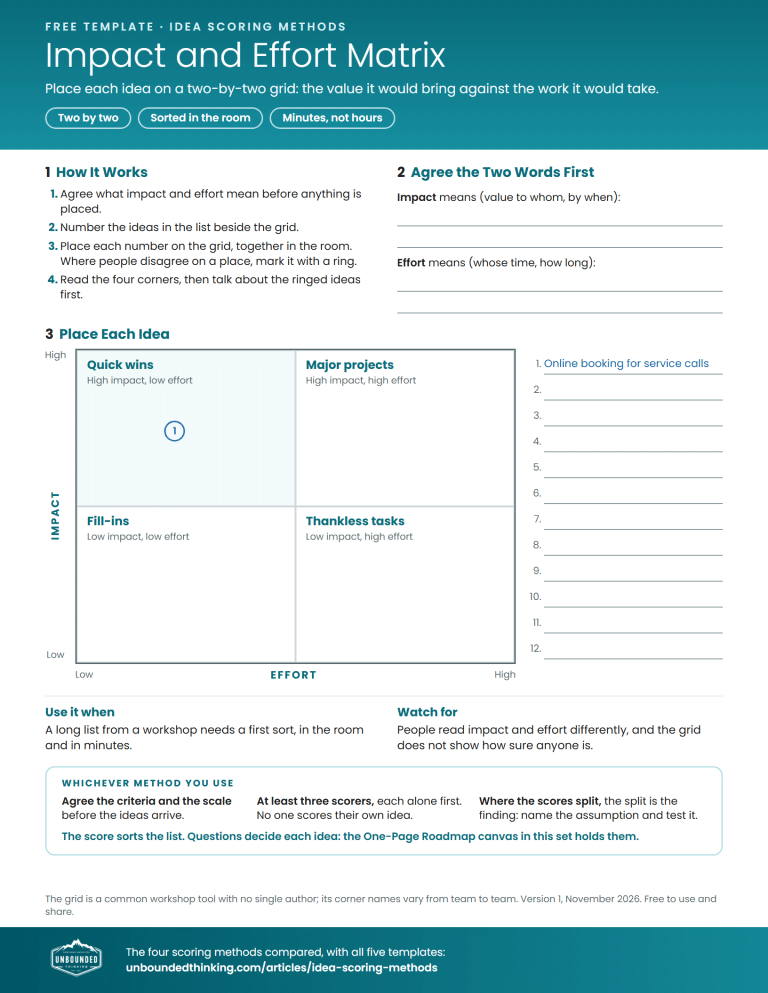
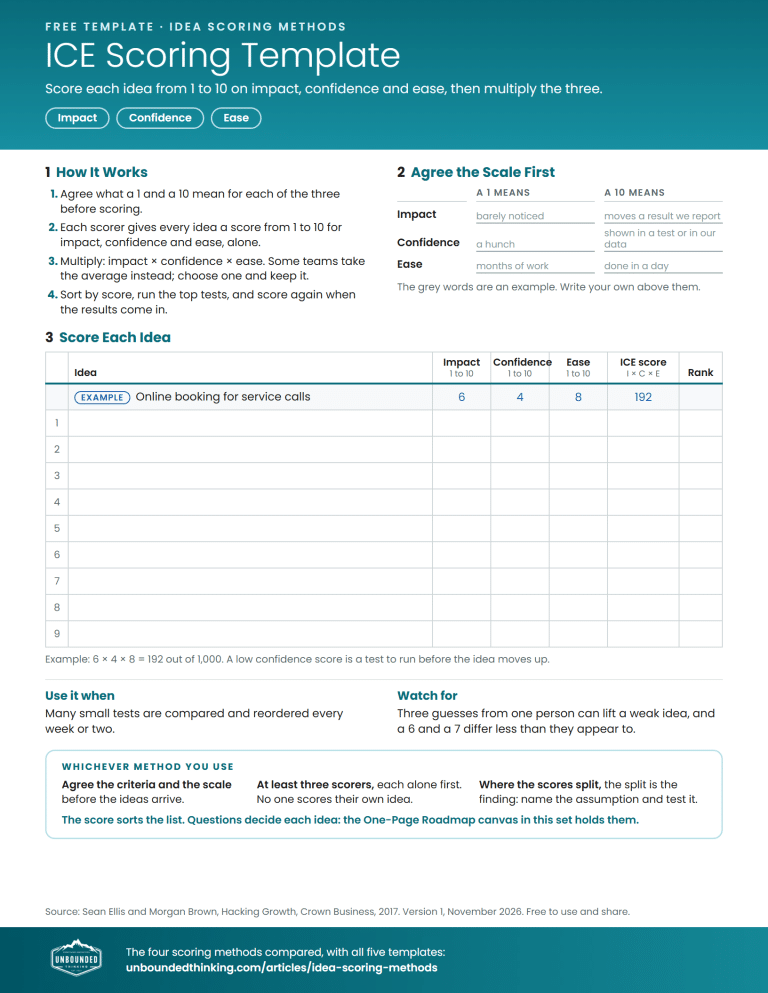
One-Page Roadmap, Basic Version
Our questions for one idea, stage by stage, on one landscape page.
PDF, one page
If You Score at All: A Checklist
Whichever method a team chooses, the same habits make its scores more trustworthy. They come from the idea reviews we run with clients, and they are explained in full in How to Evaluate Ideas With Criteria People Trust.
Before you score ideas
Criteria and scale agreed before the ideas arrive, by the people whose ideas will be judged
Ideas sorted into core, adjacent and breakthrough, each kind scored on its own sheet
At least three scorers, each scoring alone first
No one scoring their own idea
A split between scorers read as a finding, and its assumption tested small with Unbounded Thinking's 2 Hour, $20 Test
One of three answers for every idea (do it, test it more, or shelf), told to the person who raised it
For a leadership team ranking strategic initiatives, count capacity before rank: whose hours each initiative needs, and how many. How to Prioritize Strategic Initiatives When Resources Are Limited shows how to do it in one meeting.
Limited-time Q4 offer
Innovation Process Certification at 50% Off
Your team can build this on a real problem in our two-day Innovation Process Certification, for up to 10 people. Alberta organizations that book by 30 November pay half our medium business price.
Frequently Asked Questions
What is the difference between ICE and RICE scoring?
ICE scores each idea on impact, confidence and ease, usually from 1 to 10, and suits a list of small tests that is reordered often. RICE multiplies reach, impact and confidence and divides by effort. Reach counts the people a change affects in a period, so RICE suits product and service changes where that number is known. Both put a list in order. Neither sets the criteria or decides an idea.
Which idea scoring method is best?
None is best for every decision. Weighted scoring fits a short list judged on criteria that do not matter equally; the impact and effort matrix, a first sort of a long list; ICE, many small tests reordered often; RICE, changes to a product or service whose reach can be counted. Each puts a list in order. None sets the criteria or decides an idea.
What is a weighted scoring model?
A weighted scoring model rates each idea on a few agreed criteria, multiplies each rating by a weight that reflects how much that criterion matters, and adds the results into a weighted total. It is also called a weighted decision matrix. It works best when the criteria and weights are agreed before the ideas are known.
What are the four quadrants of an impact and effort matrix?
The usual names are quick wins (high impact, low effort), major projects (high impact, high effort), fill-ins (low impact, low effort) and thankless tasks (low impact, high effort). Teams name them differently. Agreeing what impact and effort mean before any idea is placed matters more than the names.
Does Unbounded Thinking use idea scoring?
No. We describe the common methods because many teams use them, but in our own work we ask questions of each idea instead: whether the organization is ready, what the real problem is, what the right idea is, and how to test and implement it. A score sorts a list. The questions decide each idea.
Are the idea scoring templates free?
Yes. The weighted scoring, impact and effort, ICE and RICE templates and the One-Page Roadmap canvas (basic version) are one-page PDFs, free to download with no form and free to use and share. All five are also in a single five-page file.
About the author

Shannon Phillips
Co-Founder and Innovation Strategist
Designs structured innovation systems for enterprise organizations and helps leadership teams set priorities that reflect how the organization operates.
Related Articles

Innovation Execution
How to Evaluate Ideas With Criteria People Trust

Innovation Execution
How to Prioritize Strategic Initiatives When Resources Are Limited

Innovation Execution