The New Standard of Trust: ISO 56001 and the End of Innovation Theater

In 2026, innovation is no longer a creative spark. It is a business system you can certify.

For decades, growth ran on instinct and ad-hoc creativity. That era is closing. With the release of ISO 56001:2024, innovation joins quality and environmental management as a discipline you are expected to prove, not perform. Workshops, hackathons, and idea boards that produce no measurable value now have a name on the audit floor: innovation theater. To win high-value contracts and stay inside global supply chains, you have to show the systematic capability to deliver under uncertainty, not just claim it.

Author: Shannon Phillips

The Strategic Shift: Why ISO 56001 Is Now Mandatory

The move from guidance to requirement is a structural change in how organizations are valued. Innovation is leaving the “department of ideas” and becoming a core business function with the same accountability as any other.


From “Should” to “Shall”

Until 2024, innovation sat under ISO 56002, a guidance document full of suggestions and no teeth. ISO 56001:2024 introduces the mandatory “shall” requirements that make formal, third-party certification possible. In practical terms, it puts innovation on the same footing as Quality Management (ISO 9001) and Environmental Management (ISO 14001): a system that gets audited, not a slogan that gets posted.


Procurement Is Moving First

Public buyers are rewriting their rules around maturity and value rather than lowest price.

  • The proxy for reliability. Governments treat certification as shorthand for trust: proof that a bidder can manage the uncertainty baked into complex, technology-heavy projects.
  • Alberta’s 2030 strategy. The province is targeting 20,000 new jobs and $5 billion in annual revenue. On that trajectory, certification is likely to shift from a preferred qualification to a hard requirement for high-value technology and infrastructure contracts.
  • EU procurement reform. The reform planned for 2026 is being shaped around a “principle of result”, weighting quality and outcomes over the cheapest bid.
  • Canadian federal tendering. Federal procurement is modernizing toward best value rather than lowest price, the same direction of travel.


Supply Chain Exclusion

The pressure is not only top-down. Large anchor firms are starting to require certification from their partners to contain geopolitical and operational risk. If you cannot prove your innovation maturity, the cost is not a lower score. It is being cut at the prequalification stage, before anyone reads your proposal.

Decoding the Standard:
The Clauses Auditors Actually Check

You do not need to memorize the whole standard, but leadership should know where the audit pressure lands. Three clauses carry most of it.

Leadership and Commitment

5

Auditors look for unalterable evidence that the top of the house is actively running the innovation system, not just endorsing it.

  • The requirement. Leaders must set innovation objectives and align them with company strategy.
  • The evidence gap. Meeting minutes rarely cut it. Auditors want timestamped proof of leadership in the decisions that matter most: the calls to pivot or kill.

8

Operations and Managing Uncertainty

This is the engine of the system. It replaces gut feeling with structured experimentation.

  • The requirement. You must run real processes to spot opportunities, shape concepts, and validate solutions.
  • The operational reality. Proof means documented risk assessments at every stage of the funnel, not a single business case written after the fact.

9

Performance
Evaluation

Here the standard stops counting ideas and starts measuring value.

  • The requirement. Continuous monitoring of how well the system actually performs.
  • The benefit. Regular reviews force the organization to learn from failures instead of quietly repeating them.

The Human Factor: Thawing the “Frozen Middle”

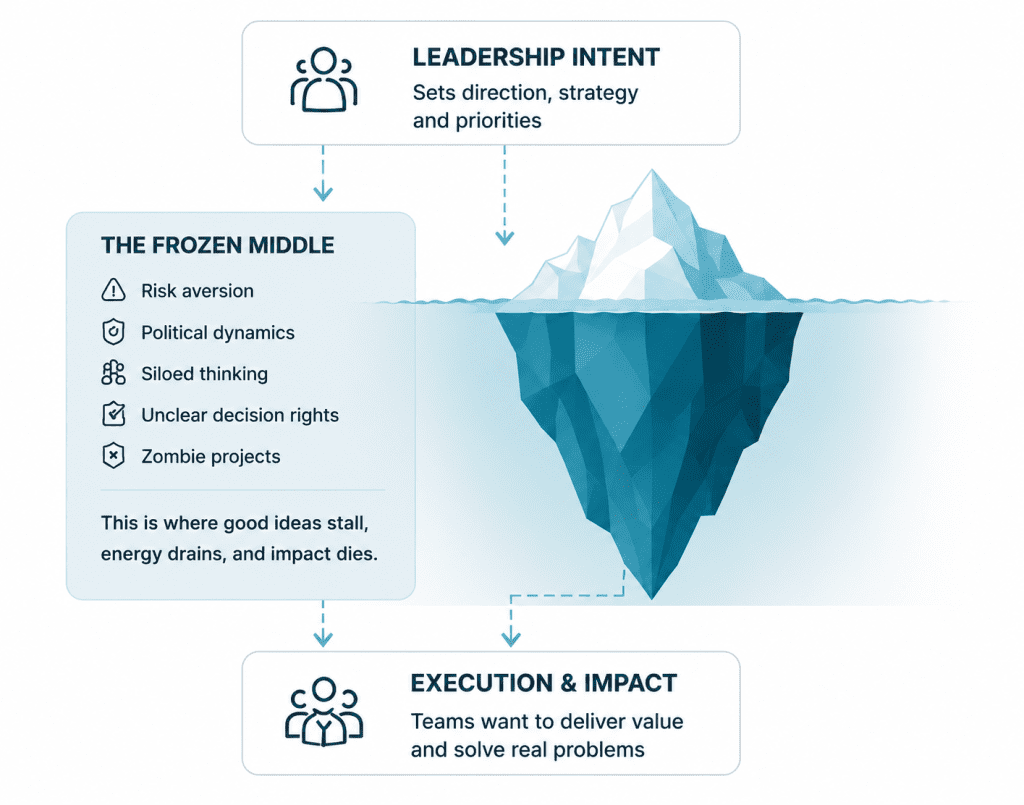
Innovation rarely dies at the idea. It dies in the cultural layer, where managers protect what they know and projects nobody believes in refuse to end. ISO 56001 gives you the governance to fix both.

The Competence Trap

Your strongest managers often resist change because it threatens the expertise that made them strong. Framing innovation as a systems approach turns it into a repeatable skill the whole team can build, rather than a threat to a few careers.

Safe-To-Fail-Zones

By mandating the Managing Uncertainty principle in Clause 8, the standard gives middle managers cover to experiment without betting their job on a single pilot.

Transparency and Engagement

When people watch their ideas judged against clear, auditable criteria instead of an executive’s mood, initiative fatigue fades and engagement climbs.

Transparency and Engagement

A zombie project survives because no system has the authority to kill it. ISO 56001 supplies the criteria to retire initiatives on evidence rather than sentiment.

The 8 Principles of a Compliant System

To pass a 2026-era audit, your organization must demonstrate competence across all eight core pillars. These are the metrics by which your readiness is measured.

ISO 56001 Core Principle Organizational Impact Audit Evidence Required
Realization of Value
Organizational Impact
Shifts focus from idea volume to financial or social impact.
Audit Evidence
Documented ROI, social value metrics, and stakeholder feedback.
Managing Uncertainty
Organizational Impact
Replaces risk avoidance with structured experimentation.
Audit Evidence
Stage-gate risk assessments and pivot/kill decision records.
Strategic Direction
Organizational Impact
Ensures innovation is not decoupled from core business goals.
Audit Evidence
Alignment maps between portfolios and corporate strategy.
Innovation Culture
Organizational Impact
Measures the systemic support for risk-taking and learning.
Audit Evidence
Training records and failure analysis reports.
Future-focused Leadership
Organizational Impact
Prioritizes long-term viability over short-term gains.
Audit Evidence
Strategic plans, resource allocation logs, and sign-offs.
Systems Approach
Organizational Impact
Views innovation as interconnected processes, not silos.
Audit Evidence
End-to-end workflow documentation and integrated data flows.
Exploiting Insights
Organizational Impact
Systematic capture of internal and external data.
Audit Evidence
Trend scouting logs and customer insight databases.
Adaptability
Organizational Impact
Ensures the management system itself evolves with the market.
Audit Evidence
System review minutes and process improvement logs.
The Bottom Line: Competence across all eight pillars is no longer optional — it is the new standard for innovation leadership.

The Cost of Non-Compliance

As innovation management becomes more structured and evidence-based, periodic check-ins are no longer enough. Relying on disconnected spreadsheets, email threads and local files makes it harder to demonstrate consistent governance, maintain reliable records and show how decisions were made.

Audit Risk

Fragmented systems make evidence harder to prove.

When information lives across spreadsheets, inboxes and shared drives, it becomes difficult to demonstrate which version was current, who approved it and when changes were made.

Greater risk of missing evidence, inconsistencies and additional work during audits or reviews.

Lost Knowledge

Important decision history can disappear.

Innovation involves experiments, pivots and decisions to stop projects. When the reasoning behind those decisions lives in meetings or email threads, valuable organizational knowledge can be lost when people or priorities change.

Repeated mistakes, duplicated effort and slower organizational learning.

Lost Capacity

Rebuilding evidence instead of progressing work

Manual systems create administrative work around collecting documents, confirming approvals, tracing decisions and rebuilding project histories.

More time spent preparing evidence and less time available for innovation, experimentation and execution.

Lost Opportunity

Weak governance undermines credibility.

Customers, partners, funders and procurement teams increasingly expect innovation to be managed systematically, not through isolated projects or informal processes.

Reduced confidence, slower approvals and missed opportunities where strong governance and documented capability matter.

The Bottom Line

Manual systems create hidden costs that compound over time.

A formal Innovation Management System creates a consistent way to capture decisions, preserve knowledge, demonstrate governance and connect innovation activity to measurable outcomes.

People Also Ask

ISO 56002 provided guidance and best-practice suggestions. ISO 56001:2024 is a requirements standard containing mandatory “shall” statements necessary for formal third-party certification.

By 2027, it is highly probable that ISO 56001 certification will move from a preferred qualification to a mandatory requirement for high-value technology and infrastructure contracts in jurisdictions like Alberta and Federal Canada.

Governments use the standard as a proxy for reliability to ensure that suppliers have a systematic process for managing the risks and uncertainties inherent in complex, technology-intensive projects.

This refers to performing visible innovation activities, such as hackathons or idea workshops, that lack measurable value realization or strategic alignment with core business goals.

A systems approach views innovation as interconnected processes rather than siloed projects. This ensures that every dollar spent becomes a high-quality delivery for stakeholders by aligning innovation with strategic corporate goals.

Yes. Certification boosts an organization’s fundability by demonstrating to venture agencies, grant providers, and institutional investors that your innovation capability is systematic and accountable.

Like most ISO management standards, organizations typically undergo a full certification audit every three years, with regular annual surveillance reviews to ensure the system evolves alongside changing market conditions.

The ISO 56000 family is a comprehensive suite of standards designed to support different aspects of innovation management. The core standards include:

  • ISO 56000: Fundamentals and vocabulary

  • ISO 56001: Requirements (the certifiable standard)

  • ISO 56002: Guidance and best practices

  • ISO 56003: Tools and methods for innovation partnerships

  • ISO 56004: Innovation management assessment

  • ISO 56005: Intellectual property management

  • ISO 56006: Strategic intelligence management

  • ISO 56007: Idea management

  • ISO 56008: Innovation operation measurements

Certification is the destination, but building systemic capability is the journey. If you are not ready for a formal audit, you should still build the infrastructure. Start with these three steps:

  1. Deploy an Innovation Readiness Assessment (IRA): Establish a baseline of your current capabilities and identify exactly where execution breaks down across your people and processes.

  2. Develop a Strategic Blueprint: Align your leadership team around a clear roadmap so you know exactly what to start, stop, and scale.

  3. Adopt a Digital Portfolio System: Move your initiatives out of spreadsheets and into a unified digital system for managing your portfolio. This builds your audit trail passively, so when you are ready for certification, the evidence is already there.

Quick Wins: Your 30-Day ISO 56001 Roadmap

This section provides low-friction, high-value steps the reader can take right now to move away from “Innovation Theater” without feeling overwhelmed by a massive multi-year overhaul.

Perform an IRA Diagnostic

Identify exactly where your current execution breaks and pinpoint your compliance gaps.

Digitize Your "Kill" Criteria

Move project decision-making out of messy email threads and into a timestamped governance workflow.

Establish a Shared Mandate

Align leadership and teams on a single, high-velocity strategy to reclaim the 30% capacity lost to "Zombie Projects".

Launch a Compliant Funnel

Create a secure portal for open innovation that maintains strict governance controls from day one.

Perform an IRA Diagnostic:

Identify exactly where your current execution breaks and pinpoint your compliance gaps.

Digitize Your "Kill" Criteria:

Move project decision-making out of messy email threads and into a timestamped governance workflow.

Establish a Shared Mandate:

Align leadership and teams on a single, high-velocity strategy to reclaim the 30% capacity lost to "Zombie Projects".

Launch a Compliant Funnel:

Create a secure portal for open innovation that maintains strict governance controls from day one.

HOW KWOKKA by UBT™ OPERATIONALIZES ISO 56001

From Requirements to a Working System

KWOKKA by UBT™ connects readiness, strategy, decisions and evidence in one structured innovation management system, so governance happens as the work happens.

Centralize decisions & evidence

Keep the history of innovation in one place.

Build governance into the workflow

Create consistent pathways for progress, pivot and stop decisions.

Connect strategy to execution

Keep initiatives aligned with organizational priorities.

Create an ongoing evidence trail

Capture governance evidence as work progresses.

Unleash Your Potential With Our Tailored Innovation Services

At Unbounded Thinking, we live and breathe innovation. Bound by a firm conviction that every organization holds untapped potential, we’re here to help you unlock it.

Ready to strengthen your innovation system?

Whether you're preparing for ISO 56001, uncovering governance gaps or building a more disciplined approach to innovation, the best place to start is understanding where your organization stands today.