

In this article
Innovation Workshops
In each workshop, participants work through their own ideas using a structured innovation process.
Find the Right WorkshopKey takeaways
Before sending the invitation, name the decision the session must produce and the person who makes it.
Write one clear question, and send it with three or four criteria two working days ahead.
Ask participants to write ideas alone before the group discusses them.
Keep the second half of the session for narrowing the list and choosing.
Record an owner, a next step and a date for each chosen idea before people leave.
Why Most Brainstorming Sessions End Without a Decision

Definition
Brainstorming session
A meeting in which a group produces many possible answers to one question and holds back judgement until the ideas have been shared.
Most guidance on how to run a brainstorming session concentrates on the middle of the meeting: warm-up exercises, techniques for producing ideas and rules that keep the discussion open. Those methods produce a long list of ideas. They do not produce a decision.
A session ends without a decision when the decision was never prepared: the group does not know what will be chosen, who will choose or on what basis.
A session that ends in decisions has four parts, and the first is complete before anyone enters the room:
1
Prepare
The decision, the question and the criteria

2
Generate
Ideas written alone, then shared
3
Converge
The list narrowed against the criteria
4
Commit
Choices, owners and next steps
This article covers the session itself. The weeks that follow are the subject of its companion, what to do after brainstorming.
Before the Session: Name the Decision and Who Makes It
The first step in how to run a brainstorming session is to state the result it must produce as a decision, such as which two ideas for reducing order errors will be tested next quarter. A topic such as “ideas for the warehouse” gives the group nothing to choose.
Next, name the person who makes that decision. Three arrangements work, provided participants know in advance which one applies:
In the session
The Group Decides
Participants choose together, by vote or by scoring, and the result stands.
In the session
The Leader Decides
The group recommends, and the decision maker chooses before the session closes.
By a set date
The Leader Decides Later
The group recommends a short list. The decision maker answers by a date announced in the session.
Trust is lost when participants believe the group is deciding and later learn that it was advising.
Write One Clear Question
The question sets the limits of the session. A broad topic invites ideas that cannot be compared, and a question that contains its own answer leaves the group nothing to add. A useful question names the problem and the result wanted, and leaves the solution open.
Instead of
Ideas for improving onboarding
How to increase sales
Thoughts on the new intranet
Try this
How might we halve the time a new employee needs before taking a customer call alone?
How might we win a second order from customers who bought once this year?
How might we make the five most used forms easier to find?

In practice. Send the decision, the question and the criteria to participants at least two working days before the session.
Invite the People the Decision Needs
Choose participants for what the decision requires, and keep the group small enough that everyone contributes. Five to eight people is a workable size for one facilitator.
The decision maker, or a delegate with the authority to choose.
People who do the work the question concerns.
Someone who will carry out the result, so that practical limits are heard early.
One person from outside the team, who will question what the team no longer notices.
Seniority changes what people are willing to say. Ask leaders to contribute in writing with everyone else and to speak last in the discussion. Our guide to innovation culture explains why capable people stay silent in meetings.
Agree the Criteria Before Anyone Has an Idea
Once ideas are on the wall, people defend their own, and any criterion proposed at that point reads as an argument for one idea. Before the session, no one has an idea to protect.
Three or four criteria are enough. The decision maker proposes them in the invitation, and the group confirms them in the opening minutes. For example:
The idea answers the question as written.
A first test can run within the quarter, inside the budget stated in the invitation.
The result can be measured against a figure the team already tracks.
Someone in the session is willing to own it.
Key idea
Criteria set before the session produce a decision that can be explained to the people whose ideas were not chosen.
How to Structure a Brainstorming Session: Generate, Then Converge
Generating ideas and judging them are different kinds of work, and a group does both poorly when it mixes them. Divide the session into separate phases.
Begin the generating phase in silence. In a study by researchers at Wharton and INSEAD, reported by Knowledge at Wharton in 2010, groups of four that spent 10 minutes producing ideas alone and 20 minutes discussing them generated about three times as many ideas as groups that brainstormed together for the full 30 minutes. The researchers also reported that participants evaluated ideas less well than hoped under both methods.
A 90-minute session can be divided as follows:
1
Open: 10 minutes
Restate the decision, the question and the criteria. Confirm who decides and how.
2
Write alone: 10 minutes
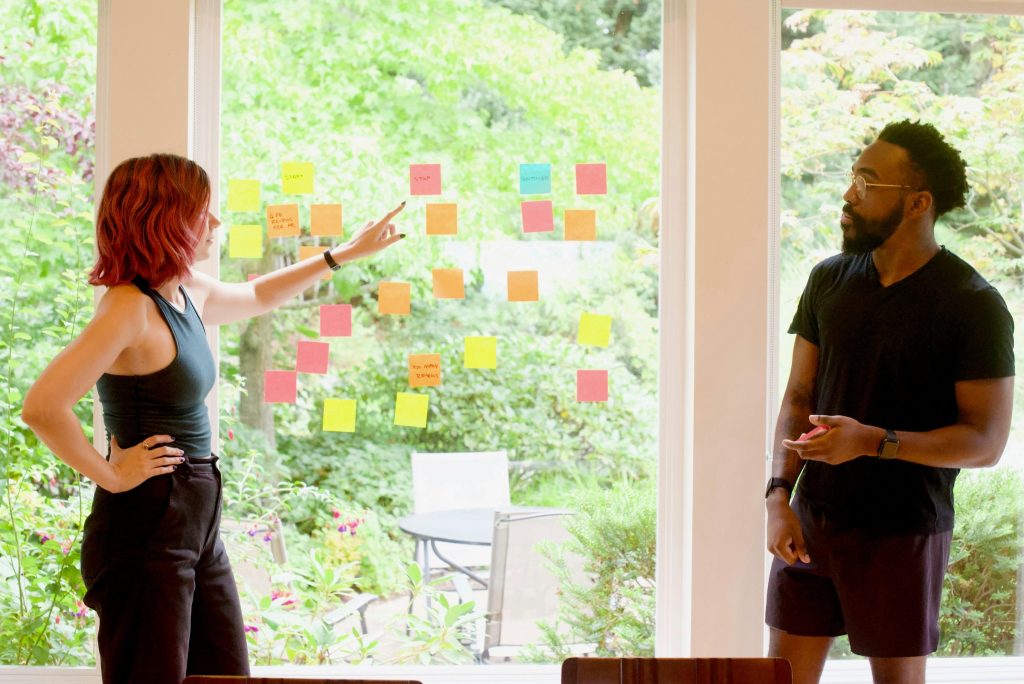
Each person writes ideas in silence, one idea to a note.
3
Share and build: 25 minutes
Each idea is read out without debate. The group combines duplicates and adds the ideas that others prompt.
4
Converge: 30 minutes
Group the ideas, score the groups against the criteria and discuss only the few that score highest.
5
Commit: 15 minutes
Confirm the choices, name the owners and agree the next steps.
In practice. When the generating phase runs long, shorten the sharing and keep the converging.
Brainstorming Session Rules and the Facilitator’s Role
The familiar brainstorming session rules protect the generating phase: hold back judgement, aim for quantity and build on the ideas of others. A session that must end in a decision needs four more:
Write before speaking. Every idea goes on a note before it is discussed, so that quieter participants are heard.
One phase at a time. No judging while the group generates, and no new ideas once it has started to converge.
The criteria decide. An idea is argued for by reference to the criteria, whoever proposed it.
The time for converging is fixed. It starts when the agenda says, whatever remains unsaid.
Advice on how to facilitate a brainstorming session often treats the facilitator as the source of energy in the room. The more useful role is to keep the process: hold the times, keep the phases separate and bring the group back to the criteria.
Our innovation workshops follow the same principle: participants work through their own ideas using a structured innovation process.

Workshops and Certification
Innovation Workshops
In each workshop, participants work through their own ideas using a structured innovation process.
Before People Leave: Choices, Owners and Next Steps
Guides on how to run a brainstorming session usually close with a reminder to follow up. A session that ends in decisions closes with commitments. For each chosen idea, record three things where everyone can see them: the owner, the next step and the date it is due.
State what happens to everything else. Ideas that were not chosen stay on the list, and participants are told when they will hear what was decided about them.
Our article on what to do after brainstorming sets out the weeks that follow: one list, a decision on every remaining idea and an answer to every participant.
How to Run a Brainstorming Session: The Checklist
How to run a brainstorming session that ends in decisions depends more on the preparation than on the technique used in the session. The six points below can go out with the invitation:
Brainstorming session checklist
The decision the session must produce is written down
The decision maker is named, and participants know how the choice will be made
One clear question and three or four criteria went out with the invitation
The agenda has participants write ideas alone before the group discusses them
The second half of the session is kept for converging and committing
Each chosen idea leaves with an owner, a next step and a date
When sessions often end without decisions, the cause is usually wider than the meeting: who has the authority to decide, and whether anyone has time to act. For a first look at where your organization stands, one person can take the free Innovation Readiness Snapshot.
Frequently Asked Questions
How to run a brainstorming session that ends in decisions?
Settle three things before the session: what will be chosen, who chooses and against which criteria. In the session, have participants write ideas alone, then use the second half to narrow the list. Close by recording an owner, a next step and a date for each chosen idea.
How do you structure a brainstorming session?
Use separate phases with fixed times: open with the decision and the criteria, write ideas alone, share and build, converge against the criteria, and agree owners and next steps. In 90 minutes, about half the time goes to converging and committing.
What are the rules of a brainstorming session?
The usual rules are to hold back judgement, aim for quantity and build on the ideas of others. A session that must end in a decision adds four: write before speaking, keep generating and judging apart, let the criteria decide, and start converging on time.
How do you facilitate a brainstorming session?
The facilitator keeps the process: holding the times, keeping the generating and converging phases separate and bringing the group back to the criteria. A facilitator with no stake in the outcome finds this easier than the manager who owns the decision.
Who should attend a brainstorming session?
Invite the decision maker or a delegate with the authority to choose, people who do the work the question concerns, someone who will carry out the result, and one person from outside the team.
How long should a brainstorming session be?
Long enough to choose as well as to generate. Ninety minutes allows 10 minutes to open, 35 to write and share ideas, and 45 to narrow the list and agree owners.
About the author

Shannon Phillips
Co-Founder and Innovation Strategist
Designs structured innovation systems for enterprise organizations and helps leadership teams set priorities that reflect how the organization operates.
Related Articles

Innovation Execution
What to Do After a Brainstorming Session

Psychological Safety
