


In this article
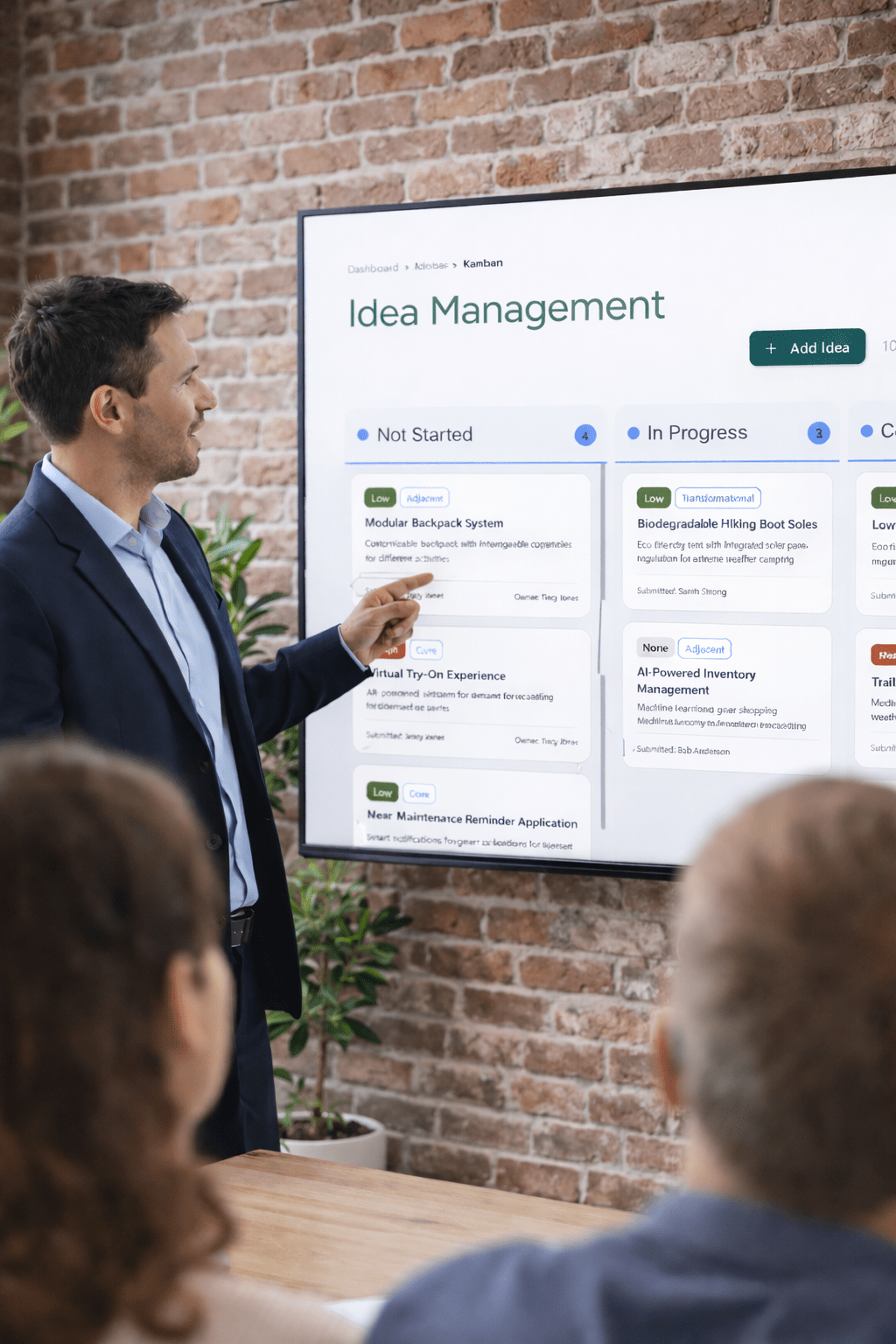
Idea Management Software
KWOKKA by UBT™ collects ideas from employees across your organization and gives each one an owner and a defined path.
Book a WalkthroughKey takeaways
Silos come from structure: separate goals, separate idea lists and separate criteria, not unwilling people.
The Silo Tax is the cost of that disconnection: work done twice, ideas with no owner, projects nobody stops.
Team-building and new tools rarely break down silos, because they leave the structure as it was.
Give departments shared work: one idea list, the same criteria and a mixed team for each shared problem.
Start with one problem that crosses a department line, and show the result to everyone.
Why Silos Form in Organizations

Definition
Organizational silos
Departments that work toward their own goals with their own information, so that problems and ideas which cross a department line have no owner and no place to go.
Most advice on how to break down silos treats them as an attitude: people who will not share. In our experience the people are rarely the cause. Silos form because each department has its own targets, its own list of ideas, its own idea of what is worth doing and its own words for it. People do what their department is measured on, and nothing in that structure rewards work that crosses the line.
Departments themselves are not the problem. Specialist teams are how an organization gets good at things. The trouble starts with the work that belongs to no single department: the customer complaint that begins in sales and ends in operations, the improvement that would save one team time and cost another team effort, the idea from the front line that needs three managers to agree.
That work is where most of an organization’s ideas sit, because it is where things go wrong. Shannon Phillips, co-founder of Unbounded Thinking, describes what an organization has to draw on:

If there’s a thousand people within the company, that’s a collective intelligence of a thousand.
Shannon Phillips, Co-Founder and Innovation Strategist
Silos cut that thousand into small pools that rarely meet. Each department works with what it knows, and the knowledge that would solve a shared problem stays on the other side of the line.
The Silo Tax: What Silos Cost
Key idea
The Silo Tax is the measurable cost of disconnected work: between the people who improve and innovate and the people who run day-to-day operations.
We call it a tax because every organization pays it, and few see the bill. It does not appear as a line in a budget. It appears in five places that can each be counted:
Work done twice. Two departments solve the same problem in different ways, and neither knows about the other.
Ideas with no owner. An idea that touches two departments is passed between them until it is forgotten.
Zombie projects. Projects continue because no one sees the whole list, so no one stops the ones that no longer matter.
Waiting. Work stops at each handover between departments, and nobody owns the wait.
Silence. People stop raising problems that belong to another department, because nothing happens when they do.

In practice. Estimate your own Silo Tax for one quarter. Count the problems solved twice, the ideas that crossed a department line and went nowhere, and the projects that no one has reviewed in six months. The count is usually enough to start the conversation.
Silos Run Up and Down as Well as Across
Most writing about silos looks sideways, at departments. The silo that costs most is often vertical: between the front line, where problems are seen every day, and the people who decide what gets fixed. An employee who sees the same fault every week has no route to the manager who could fund the fix, so the fault stays.
Problems are discussed at the front line for months before a manager hears of them.
Ideas are sent up and no answer comes back.
Decisions arrive from above with no reason given.
Shannon contrasts top-down ideas with collective intelligence, and the vertical silo is where the difference shows. When ideas only travel down, an organization uses what a few people know. When they also travel up, and each one gets an answer, it uses what everyone knows. Our article on how to respond to employee ideas sets out how to keep them travelling up.
Why Team-Building and New Tools Do Not Break Down Silos
The usual remedies change how departments feel about each other, or how they send messages. They leave untouched what each department is measured on and how its ideas are decided, so the silos return within weeks.
Instead of
A social event across departments
A new messaging tool for everyone
A call from the top to collaborate more
A reorganization that moves the lines
Try this
A real problem that several departments solve together
One list of ideas every department can see
The same criteria for every idea, whoever raised it
An owner for each piece of work that crosses a line
A reorganization deserves a special word. Moving the lines creates new silos along the new lines, and it costs months of disruption. Changing the shared work costs far less and can start this month.
Shannon puts the underlying point simply when he talks about how organizations handle ideas: “If we don’t have structure, is that going to work? No.” Goodwill between departments does not last without a shared structure for the work they do together.
How to Break Down Silos: Give Departments Shared Work
Silos break down when departments share the work, the information and the decisions about the problems between them. Six moves do most of it.
1
Agree one language
Agree what counts as an improvement or an innovation in your organization, in one sentence every department can use. Our article on how to define innovation gives a one-meeting plan.
2
Keep one list of ideas
Put every idea and problem, from every department, in one place that everyone can see: who raised it, who owns it, what was decided and why.
3
Judge every idea on the same criteria
Use the same short set of criteria for every idea, whoever raised it. Our article on idea evaluation criteria explains how to agree them.
4
Give shared problems a mixed team
When a problem crosses a department line, form a small team with people from each department involved, and name one owner for the result.
5
Make every decision visible
Every idea gets an answer that everyone can see, including a no and the reason for it. People keep sharing across departments when they see what happens to what they share.
6
Review the work together
Once a month, leaders from every department review the shared list together: what moved, what stopped and what needs a decision.
None of these moves asks people to like each other more. They give people a reason to work together and a place to see the result, and the relationships usually follow.
Start With One Problem That Crosses a Department Line
A full change to how ideas move across an organization takes time. A first result does not. Pick one recurring problem that touches two or three departments, such as a handover that keeps failing or a customer complaint nobody owns, and work it through in a month.
1
Pick
Choose one problem that crosses a department line and costs something people can see.

2
Map
Bring four to six people from each department involved and map where the work stops.
3
Test
Agree one small change and try it for two weeks, with one owner.
4
Share
Show the result to every department involved, including what did not work.
The first problem matters less than the fact that it was solved together and that everyone saw it. A shared result is the strongest argument for the next one.
Cross-Departmental Collaboration Starts With Leaders
When one person in one department is trained to run improvement work, innovation stays that department’s job. When leaders from several departments learn the same method together, they share a language for problems and ideas, and work starts to cross the lines. That is why we ask organizations to send leaders from different departments to the same workshop.
The fastest way to build an innovation habit isn’t one trained person. It’s a shared language.
The same idea sits at the centre of a learning organization, where value comes from how quickly knowledge moves between people rather than from where they sit. Our guide What Is a Learning Organization covers the structures that help knowledge move.

Idea management software
Idea Management Software That Takes Ideas to Results
KWOKKA by UBT™ collects ideas from employees across your organization, helps your team decide which ones to pursue, gives each one an owner and a defined path, and records what it delivered.
Breaking Down Silos: A 30-Day Checklist
These six steps fit in one month and need no new structure chart.
First 30 days
Count your Silo Tax for the last quarter.
Agree one sentence that says what counts as an improvement.
Start one list of ideas that every department can see.
Pick one problem that crosses a department line.
Give it a mixed team, one owner and two weeks.
Show the result to every department involved.
At the end of the month, compare the new count with the first one. That comparison is the evidence leaders need to keep going.
Frequently Asked Questions
What are organizational silos?
Organizational silos are departments that work toward their own goals with their own information, so problems and ideas that cross a department line have no owner. Departments are useful; the silo is the gap between them.
What causes silos in the workplace?
Mostly structure: separate targets, separate lists of ideas, separate criteria for what is worth doing and no shared place to see decisions. People do what their department is measured on.
How do you break down silos between teams?
Give teams shared work. Agree one language for improvement, keep one list of ideas everyone can see, judge every idea on the same criteria, give each shared problem a mixed team and one owner, and make every decision visible.
What is the Silo Tax?
The Silo Tax is Unbounded Thinking’s name for the measurable cost of disconnected work between the people who improve and innovate and the people who run daily operations: work done twice, ideas with no owner, zombie projects, waiting and silence.
How do you improve cross-departmental collaboration?
Start with one recurring problem that touches two or three departments. Bring people from each department together, map where the work stops, test one small change with one owner and show the result to everyone.
Is a silo mentality always bad?
Focus on a department’s own work is healthy. A silo mentality becomes a problem when work that crosses a department line has no owner, and when people stop raising problems that belong to another department.
About the author

Shannon Phillips
Co-Founder and Innovation Strategist
Designs structured innovation systems for enterprise organizations and helps leadership teams set priorities that reflect how the organization operates.
Related Articles

Innovation Execution
How to Evaluate Ideas With Criteria People Trust

Human-Centered Innovation
How to Define Innovation for Your Company in One Meeting

Knowledge Hub