


In this article
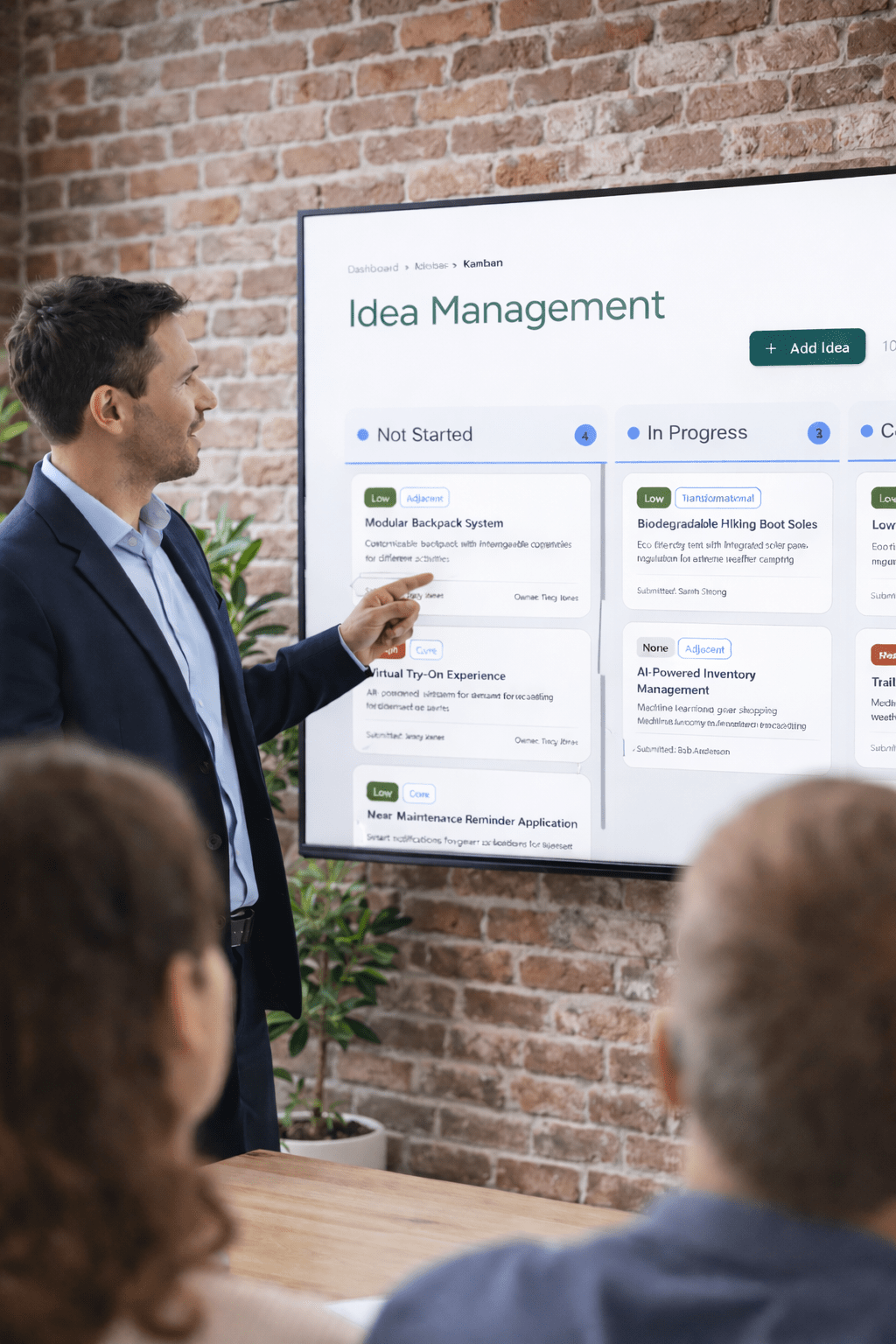
Idea Management Software
KWOKKA by UBT™ collects ideas from employees across your organization and gives each one an owner and a defined path.
Book a WalkthroughKey takeaways
Choose innovation KPIs by the decisions leaders make, and keep six to eight.
Measure inputs, pipeline flow and results. Results alone arrive too late.
Report where work is waiting for a decision, and for how long.
Show what was stopped and what was learned, beside what shipped.
Have the owner of the affected budget confirm every financial result.
Why Leaders Ignore Most Innovation KPIs

Definition
Innovation KPIs
The small set of measures an organization uses to judge whether its innovation work is resourced, moving and producing results. Each one informs a decision that leadership makes.
Most published lists of innovation KPIs are long, and most leadership teams read them once. A dashboard with thirty measures shows that work is happening. It does not show what the work delivered, or what leadership is being asked to decide.
The gap matters because leaders expect innovation to produce results. In BCG’s 2024 innovation research, most companies ranked innovation among their top priorities, and few executives reported a strong link between innovation and the strategy of the business:
83%
of companies see innovation as a top-three priority
12%
of executives say their company has a strong link between business strategy and innovation strategy
Measures that are not connected to strategy give leaders nothing to act on. This article sets out a shorter approach: a few measures, each tied to a decision leaders make. It also covers what to report when a team is accountable for innovation and does not hold the authority to decide.
Tie Each Measure to a Decision Leaders Make
A measure earns a place in the report when a leader would act differently because of it. Before choosing any innovation metrics, list the decisions leadership makes about innovation during a year. In most organizations there are three:
Resources
Fund or Hold
How much time and budget innovation work receives in the next period, and which teams receive it.
Portfolio
Continue, Change or Stop
Which projects go ahead, which need a change of direction, and which are closed.
Capability
Build or Wait
Whether managers and teams have the skills and the process to take on more.
Test each proposed measure against that list. If no decision depends on it, leave it out of the leadership report. Six measures that leaders use are worth more than thirty that they skip.

In practice. Write the decision beside each measure, in the report itself. “Median days to a decision” becomes useful when the next line reads “Decision needed: a second reviewer for ideas from operations.”
When You Are Accountable for Innovation but Do Not Decide
Many innovation teams are measured on outcomes they do not control. An innovation manager, a continuous improvement lead or a program office can collect ideas, develop them and recommend a course of action. Funding, staffing and approval sit with someone else.
In that position, a results figure alone is a weak report. A low figure may reflect the team’s work, or decisions that were never made. Report what the team controls, and report where work is waiting for a decision from leadership.
Instead of
Number of ideas submitted
Workshops and events held
A single return on investment figure
Number of projects in progress
Try this
Share of ideas that received a decision, and how long it took
Time and budget committed, against what was planned
Results by project, each confirmed by a named owner
Projects waiting for a decision, and for how long
Agree the innovation KPIs with leadership before the period starts, including the ones that describe leadership’s own part. A measure agreed in advance is read as information. The same measure introduced after a poor quarter is read as an excuse.
How to Measure Innovation in an Organization
Innovation takes time to pay back. A report that shows results alone has little to show in the first year, and its warnings arrive late in every year after that. A complete view follows the work in three parts:
1
Inputs
The time, budget and trained people the organization committed

2
Pipeline flow
How ideas and projects move, and where they wait
3
Results
What changed, and what it was worth
Inputs show whether the organization has resourced the work it asked for. Pipeline flow gives early warning: slow decisions and ageing projects appear here well before results fall. With all three, leaders can tell whether a program is under-resourced, blocked or working.
Choose two or three measures in each part. Six to eight in total is enough for a leadership report. The team can track more innovation metrics for its own use.
Innovation KPIs Examples for Inputs, Flow and Results
Each of the innovation KPIs below points to a decision, which is why leadership teams find them easy to use. Adapt the wording and the time limits to your own process.
Time committed (input). Hours each month that named people spent on innovation work, against the hours planned. It informs the resourcing decision.
Budget released (input). The share of the approved innovation budget that teams were able to spend. A low share can point to slow approvals.
Decision rate (flow). The share of submitted ideas that received a yes, a no or a “not yet” within the agreed time.
Time to decision (flow). The median number of days from submission to an answer, shown for each stage.
Age of work in progress (flow). The number of projects with no movement for 90 days. Each one needs a decision to continue or stop.
Changes in use (result). The number of implemented ideas that people are still using three months after launch.
Confirmed value (result). Hours saved, cost avoided or revenue gained, confirmed by the owner of the affected budget.
Financial results need one caution. An estimate made by the innovation team carries less weight than a figure confirmed by the leader whose budget it affects. Report fewer numbers, each one confirmed outside the team.
Report What Was Stopped as Well as What Shipped
Most innovation reports list launches, and few list the projects that were stopped. A project stopped early, on evidence, returned its people and budget to work with better prospects. That is a result.
Key idea
A stopped project is a decision made. It belongs in the report beside the projects that shipped.
For each stopped project, state what was learned, what it cost and where the released time went. Report the opposite case as well: projects that deliver nothing and have not been closed. We call these zombie projects, and their number is one of the most useful innovation metrics a leadership team can see. Our guide to innovation portfolio management covers how to review a portfolio and decide what to stop.
Measures That Mislead Leadership
Some widely used innovation KPIs make a program look healthy while telling leaders little. Three appear on most published lists:
Ideas submitted. A high count shows participation. It says nothing about whether any idea was answered or used, and it rewards volume.
Events held. Workshops and hackathons are activity. Report what happened to the ideas afterwards.
Return on investment in the first year. Early projects carry costs and few returns, so the figure understates the work. Use pipeline flow as the early measure, and add financial results as projects mature.
Keep counts of activity in the team’s own tracking, and leave them out of the leadership report.
Collecting the figures by hand works for a small program. As the number of ideas grows, idea management software records owners, decisions and dates as the work happens, so the report draws on data that already exists.

Idea management software
Idea Management Software That Takes Ideas to Results
KWOKKA by UBT™ collects ideas from employees across your organization, helps your team decide which ones to pursue, gives each one an owner and a defined path, and records what it delivered.
A One-Page Innovation Report for Leadership
Put together, the measures fit on one page, issued on a fixed schedule. Keep the layout the same each time, so that changes are easy to see.
Leadership innovation report checklist
The decisions requested from leadership, listed at the top
Six to eight measures, covering inputs, pipeline flow and results
Each measure shown against the previous period and the agreed target
Results confirmed by the owner of the affected budget
Projects stopped this period, with what was learned and what was released
Projects waiting for a decision, with the name of the person who decides
A report also needs a starting point, because an improvement cannot be shown without a baseline. The Innovation Readiness Assessment asks your whole team how the organization handles process, people, projects and performance, and gives you a baseline to compare against later. For a first look, one person can take the free Innovation Readiness Snapshot.
Frequently Asked Questions
What are innovation KPIs?
Innovation KPIs are the small set of measures an organization uses to judge whether its innovation work is resourced, moving and producing results. The useful ones are tied to a decision that leadership makes, such as what to fund, continue or stop.
What is the difference between innovation metrics and innovation KPIs?
Innovation metrics are any measures of innovation activity or results. Innovation KPIs are the few metrics chosen for reporting because a decision depends on them. A team may track many metrics and report six to eight KPIs to leadership.
How do you measure innovation in an organization?
Measure three parts of the work: inputs (the time, budget and trained people committed), pipeline flow (how ideas and projects move, and where they wait) and results (what changed and what it was worth). Two or three measures in each part are enough.
What are examples of innovation KPIs?
Examples include hours committed against the plan, the share of ideas that received a decision within the agreed time, the median days to a decision, projects with no movement for 90 days, implemented ideas still in use after three months, and value confirmed by the budget owner.
How many innovation KPIs should a leadership report include?
Six to eight is enough for a leadership report: two or three each for inputs, pipeline flow and results. The innovation team can track more for its own use. A measure belongs in the leadership report only if a decision depends on it.
Should stopped projects appear in an innovation report?
Yes. A project stopped early, on evidence, released people and budget for other work. Report what was stopped, what was learned and where the released time went, along with any projects that deliver nothing and have not yet been closed.
About the author

Shannon Phillips
Co-Founder and Innovation Strategist
Designs structured innovation systems for enterprise organizations and helps leadership teams set priorities that reflect how the organization operates.
Related Articles

Innovation Execution
What to Do After a Brainstorming Session

Psychological Safety
How to Respond to Employee Ideas So People Keep Sharing
Foundations